|
![New at the Gallery - The latest happenings, art pieces, artists, and activities at Lanning Gallery [Sedona, Arizona]](../images/categorytitles/new-at-gallery-title.jpg)
|
| |
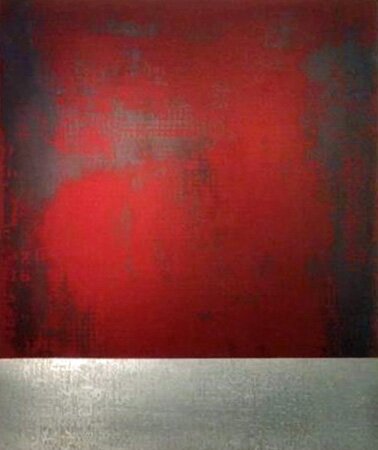
"Urban Relic Red 10" by Elisabett Gudman
56"h x 44"w x 2"d
|
|
|
|
|

|
| |
|
Victor Yurivilca
|
| |
|
To find the influence for jewelry artist Victor Yurivilca's work one must look to the entire world. From the small town high in the Andes Mountains of Peru, where he was born, Yurivilca moved first to the big city of Lima, where he was raised and went to school, including three years at a civil engineering college. But that was enough to set him off to seek far broader horizons.
Yurivilca spent the next five years traveling to myriad countries, sampling all manner of cultures and absorbing the essence of the places deep into his soul. Germany, France, Italy, Spain, Austria, Switzerland, and Luxemburg all knew the budding artist, as did Mexico, Guatemala, Ecuador, El Salvador, Panama, Aruba, the Galapagos Islands, Chile and Peru itself, from north to south and east to west.
|
| |
|
In the early '90's Yurivilca moved to the United States from the increasing turmoil of his Andean hometown. It was while, naturally, he traveled to each corner of this wide country that Yurivilca began to see himself as something beyond the engineer to which his studies may have led him. Always, from a very early age, Yurivilca had success creating things with his hands, from the toys made from recycled wood he crafted as a child to his time in engineering school to the jewelry designs he now began to create.
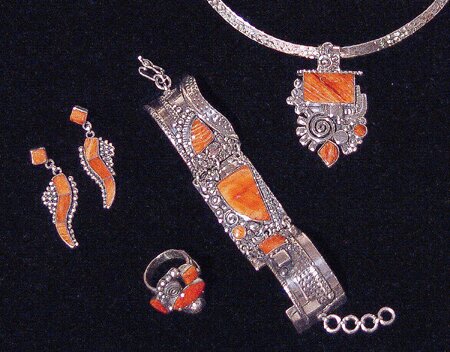
His natural skills found for him the perfect outlet to combine his own culture with all the cultures to which he'd experienced. Working with various stones and shell from around the world, such as mother of pearl, spiny oyster, crysocolla, sodalite, serpentine and black onyx, combined with sterling silver, Yurivilca now creates remarkable jewelry, one piece at a time. Whether it is a pair of earrings, a ring, a pendant or a bracelet, he devotes himself to the challenge of working out each unique design. A small ring can take roughly 12 hours to create while Yurivilca may work up to three weeks on a necklace.
For him, working out the design of each piece, knowing precisely when each piece is complete and ready to be let go, is the joy and the challenge of his expression. "It is a good expression of myself," he explains, "putting together what I think and transmitting those ideas to my hands." It is a way for Yurivilca to reach deep into his heart and soul to create truly original works that allow him to connect with others. "I wait for the right time to create," he explains, "the moment when I’m filled with good moods and full of energy. It is with this energy, the reason I feel a connection to every piece. The work truly comes from inside me."
Yurivilca's jewelry creations have been met with much acclaim. His awards include:
Tempe Festival of the Arts, AZ – 2006 & 2011 - Best of Jewelry
Millbrae Art and Wine Festival, CA – 2010 - Best of Jewelry
Southwest Arts Festival, CA - 2011 - Award of Merit
Sedona Arts Festival, AZ – 2011 - First Place
Promenade of Arts, Arlington Heights, IL - 2012 - Best of Category
Please contact the gallery to see more from this artist.
|
|
A Variety of Pieces by Victor Yurivilca
Spiny Oyster Shell & Sterling Silver
pendant 2.25" h x 1.5" w / earrings 1.5" long
ring size 9 / bracelet size is adjustable
|
|
|
|
Judith Monroe
|
| |
|
|
|
|
| |
|
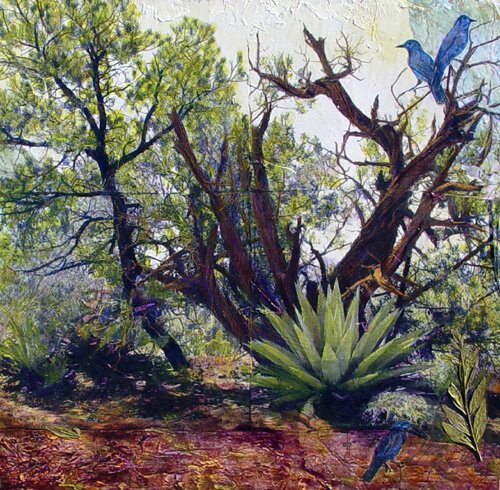
The multiple layers of Judith Monroe's nature-based artworks are, to the artist, perfect metaphors for the layers of the world around us: The photographs which make up the underlying genesis of each piece is like the physical world; the colors and various media under the artworks' surface are like the spiritual world, there for us to see and find if we take the time to look.
The singular technique that Monroe now follows to produce each mixed media piece evolved as she herself evolved as an artist. Monroe experienced the good fortune of growing up under the influence of a highly artistic mother, one who taught her how to draw in perspective and how to mix colors. By college, she had expanded her creative focus and earned a journalism degree from California State University in Sacramento. It was there that she took her first photography class. Seeing her first print come up in the developer in the darkroom completely hooked her; she changed her focus, taking every photography class offered in addition to independent study and classes in graphics arts. It was an illustration professor who first encouraged her to incorporate photography with other media.
Monroe worked first as a photographer then as a graphic artist before taking a couple of years off to have her children. Without art as a constant in her life, she noticed the difference; it re-focused her, this time to pursue precisely that which would be most fulfilling.
She returned to the darkroom and, unable to get color films and papers to produce the colors she felt and remembered from each scene of nature she strove to present, she began hand-coloring her photos, capturing the feelings of each place, capturing the emotions she had felt there. Monroe realized that her process of creation became, as she says: "a sort of looking back to Eden or forward to Heaven." The traditional hand-coloring process led her to add visual layers to her photographs right in the darkroom with photograms (placing objects directly onto the surface of photographic paper then exposing it to light), she began mixing media onto the photographs using watercolors and pencils. Her work with K-12 education programs teaching journaling and sketching led to the epiphany that incorporating all the elements of her inspiration onto her art pieces was where her heart lay. Her current collage technique was born.
Monroe begins each piece with a black and white photograph, either film or digital. She then produces an image transfer by printing the image digitally then coating the digital print with an acrylic medium. This medium pulls the ink out of the paper as it dries. She then soaks this and peels the paper off the back, leaving a transparent film with the image in it. This transfer is applied onto a prepared wood panel that often has collage elements already in place. Monroe adds texture with another acrylic medium and may add additional collage elements. She adds color with pencils, then acrylic glazes and wax pastels. Additional layers of media are possible, as each piece dictates. When the piece feels complete, she adds a coat of varnish to protect the surface and create an even finish.
Her goal is to be working nearly all the time, whether shooting pictures, processing images, pulling together collected materials or creating final pieces. When she's in full production mode, Monroe works nearly 40 hours a week, usually on several pieces at once. She can complete several smaller pieces in a week while larger ones can take a couple of weeks. The resulting landscape imagery, with dominating photos that bleed into abstracted landscapes of color and texture, hidden elements of text and sketches waiting for viewers to discover, and multiple layers of physical materials all combine to capture an unmatched experience of nature.
Monroe currently teaches darkroom photography, a class or two a semester at a local community college, to share with others the joy it has always brought her. Her work has been featured in STYLE Magazine as well as on HGTV and has won the artist numerous awards. Her images have been published by Recycled Paper Greetings and in the international publication, The Best of Photography Annual. Monroe's pieces are included in public and private collections throughout the U.S.
Please contact the gallery to see more from this artist.
|
| |
|

![Return to Homepage - Lanning Gallery [Sedona, Arizona]](../images/button/home-black-top.jpg)
![Contemporary and Southwestern Artwork at the Lanning Gallery [Sedona Arizona]](../images/sideboxes/singlesquare.gif)
![Artist Directory - Featuring some of the top Classical and Contemporary Artists from the Lanning Gallery [Sedona, Arizona].](../images/button/artist-directory-black-top.jpg)
![Art Exhibits, Art Events, and Emerging Artists - Lanning Gallery [Sedona, Arizona]](../images/button/exhibits-black-top.jpg)
![New at the Gallery - Preview all of the Latest Artwork and Artists from the Lanning Gallery [Sedona, Arizona]](../images/button/new-at-gallery-black-top.jpg)
![Contact Us - Lanning Gallery [Sedona, Arizona]](../images/button/contact-us-black-top.jpg)
![Return to Homepage - Lanning Art Gallery [Sedona, Arizona]](../images/button/home-top.jpg)
![Artist Directory of Fine Art - Lanning Art Gallery [Sedona, Arizona]](../images/button/artist-directory-top.jpg)
![Art Exhibits, Art Events, and Emerging Artists - Lanning Art Gallery [Sedona, Arizona]](../images/button/exhibits-top.jpg)
![New at the Gallery - Lanning Art Gallery [Sedona, Arizona]](../images/button/new-at-gallery-top.jpg)
![Contact Us - Lanning Art Gallery [Sedona, Arizona]](../images/button/contact-us-top.jpg)
![Member of the Sedona Gallery Association [Sedona Arizona] - A Group of Art Galleries featuring the 1st Friday Art Walk.](../images/sga-logo/SGA-Logo-50pix.jpg)
![Art and Southwest Links Directory - Lanning Art Gallery [Sedona, Arizona]](../images/button/art-links-top.jpg)