|
|
|
|
|
|
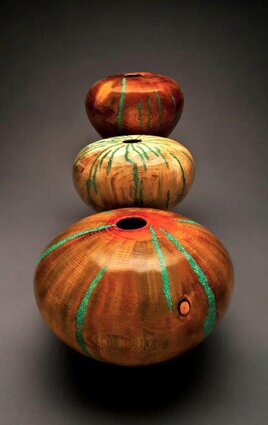
| Robert Cherry had the great good fortune to find inspiration for his artistic ambitions right in the heart of his own family. With a talented grandmother who painted in oils on canvas, Cherry found himself inspired to create, but to create in a manner that suited his own skills and ambitions. Being mechanically inclined he worked in wood as well as metal and stone; but it was wood he always returned to. The challenge of the medium, the drive to create in wood while producing something different and new, something unexpected, became an artistic path. |
|
| The refined finishes of Cherry's pieces, the exquisite shapes and frequent inlays belie the fact that Cherry is self-taught as an artist. He learns from himself: "I like to use the last piece as a stepping stone for the next, trying to bring something new to each piece." His techniques are the result of trial and error. "Occasionally, though not often, many hours of planning and labor have become fuel for the evening fire," he notes. Though, when admiring any of Cherry's stunning vessels, one can only guess that those rare occurrences are proof of an artist who strives for ever-increasing innovation and perfection. |
|
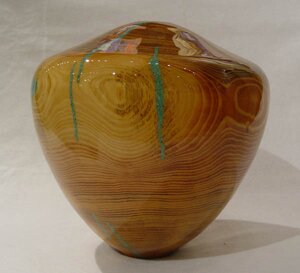
| Cherry begins by choosing "blanks" for their character and natural defects ("defects" that are desirable since he will soon celebrate them with turquoise or other accents). His "blanks" come from a variety of sources in northern and central New Mexico. He never uses wood from healthy live trees; there is an abundance of wood available from forest fires and trees brought down by natural causes. Cherry has never seen a need to cut down otherwise healthy trees. These "blanks" are "roughed out" based on their own characteristics and then are allowed to dry to 10-15 % moisture content. From there, they are final shaped in and out, and accents and/or colors are applied along with several coats of finish. The exterior is shaped using mostly conventional tooling while the interior presents quite a different challenge with access only through a relatively small hole. Cherry uses several home-grown boring bars and cutters to accomplish work on his interiors, work that, since he cannot see inside, is all done by feel and touch. |
|
|
|
| In a large shop incorporated into his home, Cherry works in silence on multiple pieces at a time (a natural process necessitated by the drying times of various of his processes). Every one of his vessels represents between 30-40 hours of work. |
|
| Often, at first glance, and even at second glance, Cherry's wood vessels are confused for glass, so smooth are their surfaces. These are artworks one needs to see and touch to fully appreciate the remarkable nature of each. |
|
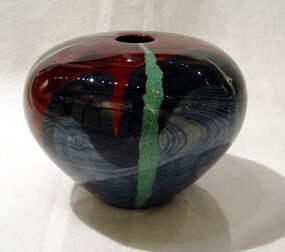
"Angry Skies #376"
Hand-turned Pine Sculpture
with Turquoise Inlay
8" x 10" x 10"
|
Click on an image to see a larger view.
"Reborn #333"
Hand-turned Pine Sculpture
with Turquoise Inlay
6" x 9" x 9"
|
|
"Sunrise in Sedona #396"
Hand-turned Pine Sculpture with Turquoise Inlay
14" x 15" x 15"
|
|
|
|
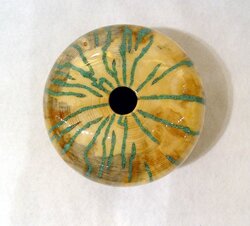
"Reborn #385"
Hand-turned Pine Sculpture with Turquoise Inlay
8" x 10" x 10"
|
|
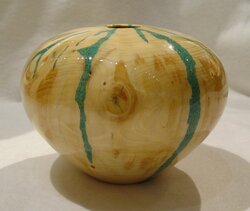
"#153 Wood Tone & Turquoise Inlay"
Hand-turned Pine Sculpture
14" x 13" x 13"
|
|
|
Artist's prices beginning at $850 up to $3,600.
|
|
|
|
|
|
Keep an Eye on this Artist. For confidential artist updates - click here to register.
|
|
|


![Return to Homepage - Lanning Gallery [Sedona, Arizona]](../../images/button/home-black-top.jpg)
![Contemporary and Southwestern Artwork at the Lanning Gallery [Sedona Arizona]](../../images/sideboxes/singlesquare.gif)
![Artist Directory - Featuring some of the top Classical and Contemporary Artists from the Lanning Gallery [Sedona, Arizona].](../../images/button/artist-directory-black-top.jpg)
![Art Exhibits, Art Events, and Emerging Artists - Lanning Gallery [Sedona, Arizona]](../../images/button/exhibits-black-top.jpg)
![New at the Gallery - Preview all of the Latest Artwork and Artists from the Lanning Gallery [Sedona, Arizona]](../../images/button/new-at-gallery-black-top.jpg)
![Contact Us - Lanning Gallery [Sedona, Arizona]](../../images/button/contact-us-black-top.jpg)
![Return to Homepage - Lanning Art Gallery [Sedona, Arizona]](../../images/button/home-top.jpg)
![Artist Directory of Fine Art - Lanning Art Gallery [Sedona, Arizona]](../../images/button/artist-directory-top.jpg)
![Art Exhibits, Art Events, and Emerging Artists - Lanning Art Gallery [Sedona, Arizona]](../../images/button/exhibits-top.jpg)
![New at the Gallery - Lanning Art Gallery [Sedona, Arizona]](../../images/button/new-at-gallery-top.jpg)
![Contact Us - Lanning Art Gallery [Sedona, Arizona]](../../images/button/contact-us-top.jpg)
![Member of the Sedona Gallery Association [Sedona Arizona] - A Group of Art Galleries featuring the 1st Friday Art Walk.](../../images/sga-logo/SGA-Logo-50pix.jpg)
![Art and Southwest Links Directory - Lanning Art Gallery [Sedona, Arizona]](../../images/button/art-links-top.jpg)